Calf 12 to 29 inch
Wide calf and plus size compression socks
Knee highs knit with extra circumference, for calves that a standard sock cuts into.
16 socks from $19.99
Open the section
Graduated compression socks
Knee highs at 15-20 and 20-30 mmHg, plus low cut ankle pairs. Sizes run from Small-Medium to 5X-Large, and the wide calf builds go up to a 29 inch circumference. Most of the range is bamboo viscose or a cotton blend rather than plain nylon.
 Wide calf16 socks
12 - 29"
Wide calf16 socks
12 - 29"
 Bamboo viscose13 socks
12 - 29"
Bamboo viscose13 socks
12 - 29"
 Firm & open toe8 socks
12 - 23"
Firm & open toe8 socks
12 - 23"
 Cotton blend6 socks
10.5 - 17"
Cotton blend6 socks
10.5 - 17"
 Ankle6 socks
sized by shoe 4 to 14.5
Ankle6 socks
sized by shoe 4 to 14.5
The catalog splits by build, because that is what decides whether a knee high stays up. Pick a section to see the gauges, the fiber content and the calf circumference each size covers.
Knee highs knit with extra circumference, for calves that a standard sock cuts into.
The cool, soft end of the range: roughly 80 percent viscose made from bamboo.
20-30 mmHg knee highs, including the toeless builds.
60 to 70 percent cotton, thicker in the shoe and warmer on the leg.
Cushioned no-show and quarter heights that stop below the calf.
Measure the fullest part of the calf, standing, with a soft tape. The table beside this box lists every calf band the catalog covers, from 10.5 to 29 inches.
Enter a measurement in inches and the matching bands light up.
Between two bands, take the larger one. The number decides the size on a knee high; shoe size only sets the length of the foot. Ankle pairs are sized by shoe size instead.| Calf | Sizes labelled | Socks |
|---|---|---|
| 10.5 - 13.5" | Small-Medium | 6 |
| 12 - 16" | XL, Small, Medium, XS(Petite), S, M | 18 |
| 12.5 - 17.5" | Medium | 2 |
| 13.5 - 17" | Medium-Large | 6 |
| 13.5 - 18.5" | Large | 2 |
| 15 - 19" | Large, L | 10 |
| 16 - 22" | 2XL | 6 |
| 17 - 21" | Medium | 5 |
| 17 - 23" | Medium | 9 |
| 18 - 22" | Large | 5 |
| 18 - 23" | 3XL, X-Large, XL | 16 |
| 19 - 24" | Large | 9 |
| 24 - 26" | 4XL | 6 |
| 24 - 29" | X-Large | 9 |
| 27 - 29" | 5XL | 6 |
Sorted by how many people have rated them. The list leans heavily toward wide calf knee highs in 15-20 mmHg, which is the combination most people are hunting for.
Three pairs of wide calf 15-20 mmHg knee high socks in neutral black, white, and grey viscose made from bamboo.
4.4 (28,832)
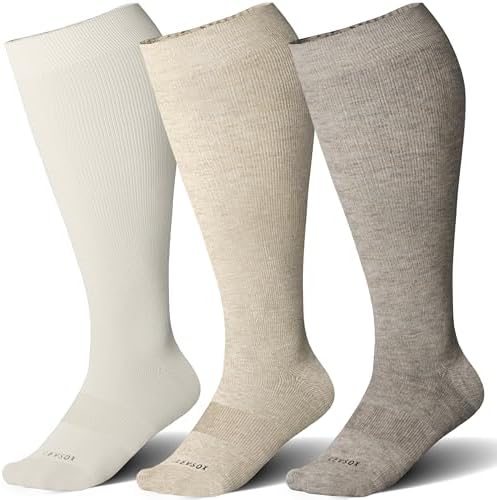
Wide calf knee high compression socks knit from bamboo viscose in muted cream, beige, and brown, built in 15-20 mmHg graduated pressure.
4.4 (21,624)
Three pairs of plain black wide calf knee highs in a bamboo viscose blend with 15-20 mmHg graduated compression.
4.4 (16,587)
Four pairs of knee high compression socks featuring a high-contrast skeleton graphic in firm 20-30 mmHg support.
4.4 (15,765)
Four pairs of knee high socks in a vivid tie dye knit, delivering firm 20-30 mmHg graduated tension.
4.4 (15,765)
Knee high compression socks in an animal print mix, knitted with firm 20-30 mmHg support across a 4-pack set.
4.4 (15,765)
Four pairs of knee high socks in mottled space dye yarns, offering firm 20-30 mmHg graduated mechanical pressure.
4.4 (15,765)
Firm graduated 20-30 mmHg knee highs in a multi-color space dye knit, packaged in a six-pair rotation for women and men.
4.4 (15,765)Both numbers describe pressure at the ankle, measured in millimeters of mercury. The knit is tightest there and eases as it climbs toward the knee. That is the whole idea behind the word graduated.
The lighter gauge, and the one most people start with. It pulls on with one hand, sits under trousers without a ridge, and is the gauge on 22 of the socks here. A long shift on your feet is the usual reason someone buys it.
Noticeably firmer. Getting it over the heel takes two hands, and rubber dish gloves make it far easier because they grip the knit instead of sliding on it. 21 socks in the catalog are cut to this gauge.
The six low cut ankle pairs are cushioned athletic socks with elastic support rather than a rated compression band. They are listed without an mmHg figure, and we have not invented one for them.
If you have a circulation condition or a leg injury, the gauge is a question for your doctor. We sell clothing and cannot answer it.
A compression sock spends eight to twelve hours pressed against skin. Plain nylon does that job cheaply and holds its shape well, but it traps heat, and by hour six a nylon knee high in a closed shoe is damp.
Viscose made from bamboo is the usual answer. It is a soft, cool fiber that moves moisture off the skin faster than nylon, so the sock stays comfortable through a long shift. Levsox blends it at roughly 80 percent with nylon and spandex, because viscose on its own has almost no recovery and a sock knit from it would bag out after one wear.
Sizing, pressure and laundry. Everything else about a sock is a matter of taste.
Where to put the tape, when to measure, and why the calf beats the shoe size on a knee high.
Read itTwo gauges in this catalog, what each feels like in the hand, and which one goes on easier.
Read itHeat is what ends a compression sock. Cool water, mesh bag, no softener, no dryer.
Read itMeasure the fullest part of your calf with a soft tape, standing, first thing in the morning. Compare that number in inches to the chart on the product page. On knee highs the calf measurement decides the size; shoe size only sets the foot length. If you land between two sizes, take the larger.
Both describe the pressure at the ankle. 15-20 mmHg is the lighter gauge and goes on with one hand. 20-30 mmHg is firm enough that most people use two hands and rubber gloves to seat the heel. If you have never worn compression before, the lighter gauge is the easier starting point.
Usually not. A standard knee high knit for a 14 inch calf stretched over an 18 inch one loses its graduated profile and rolls down, and the cuff leaves a deep mark. The wide calf builds in this catalog are knit with extra circumference for that reason, up to 29 inches at 5X-Large.
Most people do, and take them off in the evening. How long compression should be worn is a question for a doctor, not for a sock catalog, especially if you have a circulation condition or a recent injury.